Solar Panels for Overlanding: A Practical Guide
What Overlanding Solar Panels Actually Do
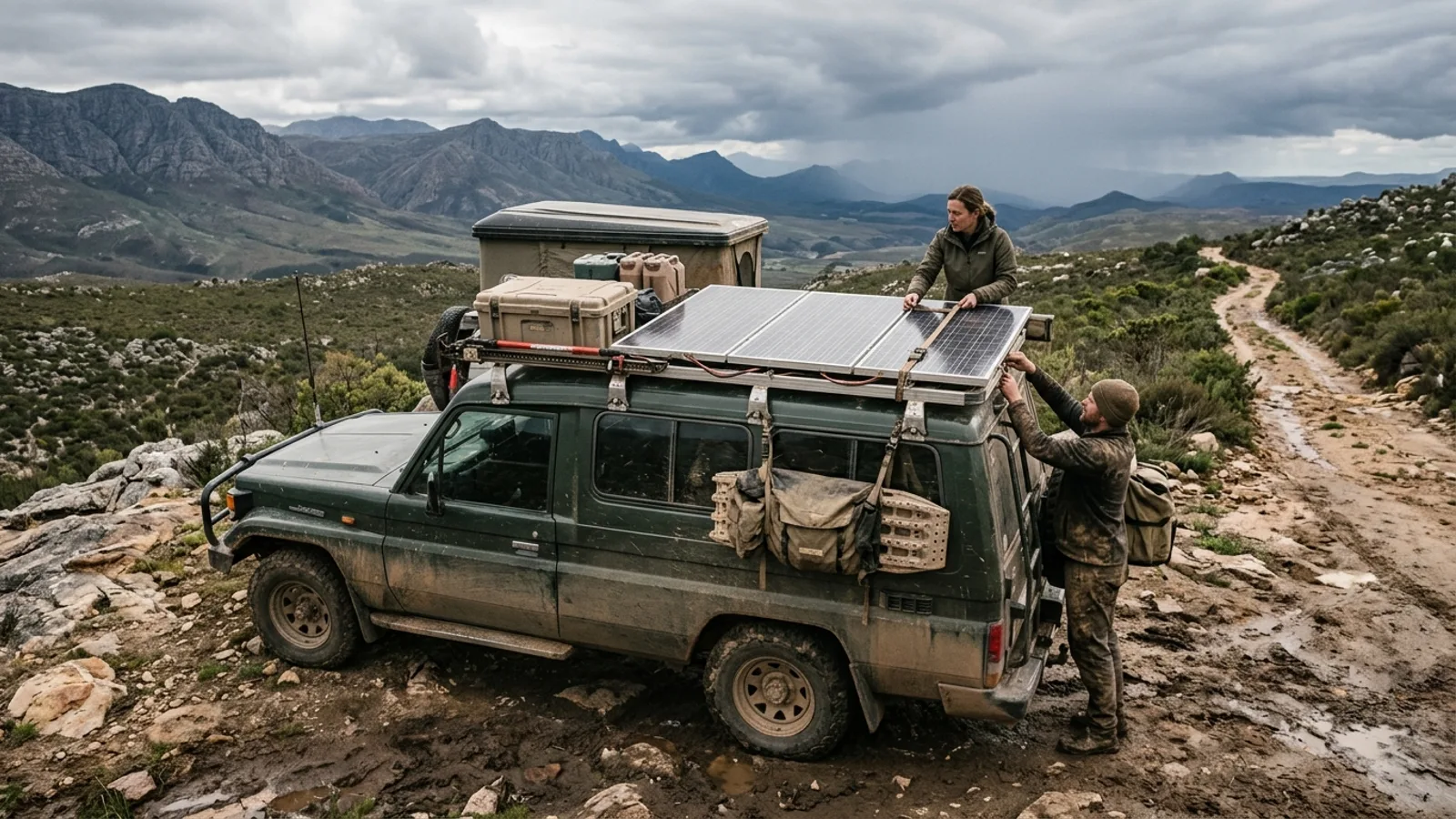
An overlanding solar setup exists to do one job: keep a secondary "house" battery topped up so you can run lights, a fridge, a fan, or charge devices without draining your vehicle's starter battery or running a generator. It is a charging tool, not a standalone power plant. Most systems pair a panel with a charge controller, a deep-cycle or lithium battery, and sometimes an inverter for AC devices.
The panel converts sunlight into DC current. The charge controller regulates that current so it charges the battery safely instead of overcharging or damaging it. From there, your battery powers 12-volt accessories directly, or feeds an inverter if you need standard household outlets.
Types of Panels and How They Differ
Monocrystalline
Made from a single continuous silicon crystal, these panels are the most space-efficient option, producing the most power per square foot. That matters when roof or hood space is limited. They tend to perform better than other types in low light or partial shade.
Polycrystalline
Built from fragments of multiple silicon crystals melted together, these panels are slightly less efficient per square foot but are a reasonable choice when you have more mounting space and want a straightforward, durable panel.
Thin-Film
These use a thin semiconductor layer on a flexible backing, so they can conform to curved surfaces and flex without cracking. They're lighter and more portable, but you'll need more surface area to generate the same power as crystalline panels, and they generally have a shorter working lifespan.
There's no universally "best" type — it's a tradeoff between available space, weight tolerance, mounting surface, and budget.
Sizing a System to Your Actual Power Needs
Before choosing panels, add up what you actually plan to run: a fridge, lights, a fan, a laptop charger, maybe a water pump. Look at the rated power draw of each device and estimate daily hours of use. This gives you a rough daily energy requirement in watt-hours, which is the number that should drive every other decision — panel wattage, battery capacity, and controller size.
It's worth building in a buffer above your calculated need. Cloudy days, shorter winter daylight, dust on the panels, and imperfect panel angles all cut into real-world output compared to a panel's rated capacity.
Batteries: The Other Half of the System
Solar panels only charge; the battery is what actually stores and delivers power when the sun isn't out. Common options include deep-cycle lead-acid, AGM, and lithium batteries. Lithium batteries are lighter and can be discharged more deeply without shortening their lifespan, but they cost more upfront and have stricter temperature limits for charging. AGM and other lead-acid variants are heavier and bulkier for the same usable capacity but tend to tolerate a wider range of conditions and rough handling.
Whatever battery you choose, match its voltage to your panel and controller setup, and don't exceed its recommended discharge depth if you want it to last.
Charge Controllers and Inverters
A charge controller sits between the panel and the battery to prevent overcharging. The two common types are PWM, which is simpler and less expensive but less efficient, and MPPT, which extracts more usable power from the panel, especially in cooler temperatures or partial shade. Larger systems generally benefit more from an MPPT controller.
An inverter is only necessary if you need to run standard AC devices — things built for a wall outlet rather than a car outlet. Size the inverter to comfortably exceed the combined wattage of whatever you'll run through it at once, since brief startup surges from things like compressors can draw more than steady-state use.
Real-World Benefits
- Quiet operation: No engine noise, which matters in shared campgrounds and backcountry sites where noise limits or etiquette discourage generator use.
- Reduced fuel dependence: Less need to carry extra fuel solely for power generation.
- Lower environmental impact: No exhaust or emissions at the point of use.
- Flexibility: Once installed, panels require little day-to-day attention beyond keeping them clean and angled toward the sun.
Practical Limitations to Plan Around
Solar output depends entirely on available sunlight, so heavily wooded campsites, extended cloud cover, or short winter days will reduce your charging significantly. Panels also add weight, require secure mounting if roof-mounted, and can be vulnerable to branches or debris if not protected. Portable panel setups need somewhere flat and sunny to sit, which isn't always available at a given site.
Because of these variables, most experienced overlanders treat solar as one part of a broader power strategy rather than a single point of failure — pairing it with efficient appliances, adequate battery capacity, and sensible power budgeting.