How to Watch TV While Camping: Streaming, Satellite, Cable, and Antenna Options
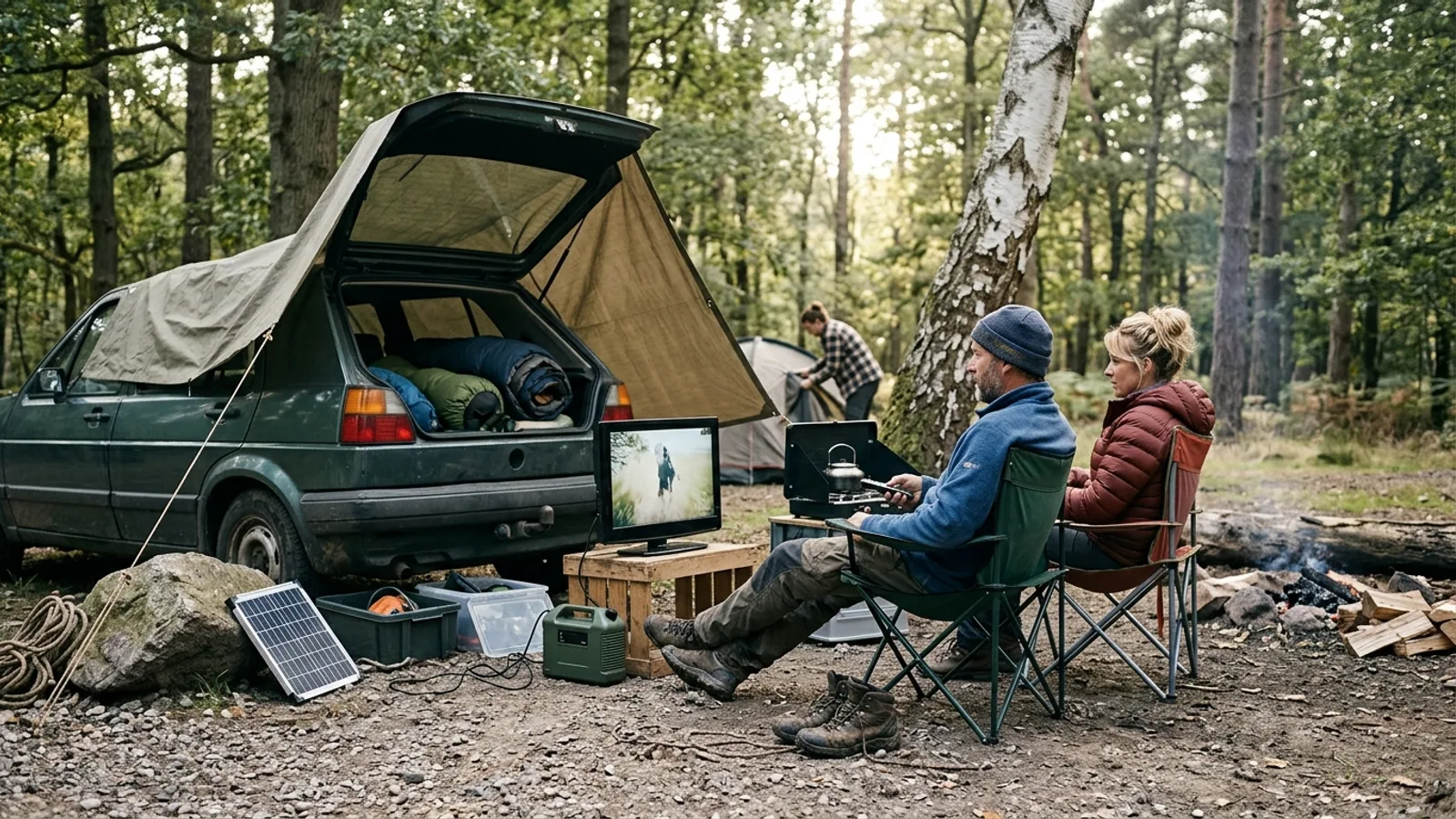
Camping doesn't mean giving up on evening entertainment. Depending on where you're staying and how much gear you want to bring, you can stream, project, or pick up broadcast and satellite signals from almost any campsite. Here's how each option actually works, and what to consider before you pack it.
Streaming Over Cellular or Wi-Fi
Streaming is the simplest option if you have decent cell coverage. Most video apps work the same in a camper as they do at home, but a few things matter more on the road.
- Data usage adds up fast. Video streaming consumes far more data than browsing or messaging. If you plan to stream regularly, check what your mobile plan allows and consider lowering the video quality setting in the app to conserve data.
- Signal varies by location. Coverage can be spotty in mountains, canyons, and dense forest, even at developed campgrounds. Check coverage maps for your carrier before you go, and have a backup plan for entertainment if you're headed somewhere remote.
- A phone hotspot can help. If a campground's Wi-Fi is weak or overloaded, using your phone's hotspot feature can sometimes give a more reliable connection for a streaming device or smart TV, though it draws on the same data plan.
To get phone or laptop content onto a bigger screen, you can connect directly with a cable adapter or use a small streaming device that plugs into the TV's HDMI port and connects wirelessly. Either approach works fine in a camper; the cable option uses less battery, while a streaming device avoids clutter.
Outdoor Movie Night with a Projector
A portable projector and screen can turn a campsite into an outdoor theater. It takes a little more setup than streaming to a TV, but it's a memorable way to spend an evening.
- Pick your spot for darkness, not just space. Projected images wash out easily, so look for a site shielded from campground lights and, ideally, wait until after dusk.
- Screens don't have to be fancy. A dedicated projector screen gives the cleanest image, but a plain light-colored sheet or tarp works reasonably well in a pinch.
- Plan your power source. Projectors draw more power than most portable speakers or lights. Confirm you have enough battery capacity or a way to run it from your vehicle or camper's power system for the length of the movie.
- Test audio and focus before dark. It's much easier to adjust projector focus and speaker placement in daylight than by headlamp once everyone is gathered around.
Satellite TV for Camping
Satellite service can reach you in places where cell signal can't, which makes it appealing for remote or off-grid camping. A compact satellite dish, often mounted on a tripod for stability, pairs with a receiver to pull in a normal range of channels.
Advantages of this approach include:
- Reception that doesn't depend on cell towers or campground internet
- Access to a broad set of channels, useful for sports or live events
- Setup that's portable and repeatable from site to site once you learn the process
The tradeoff is added equipment and setup time: aligning a dish correctly, especially around trees or hills, can take patience. It's better suited to campers who prioritize live TV over convenience.
Campground Cable Hookups
Some developed campgrounds provide a cable TV hookup at each site, similar to their electrical and water hookups. If your camper has a built-in cable input, you connect a coaxial cable from the site's pedestal to your rig.
A few practical tips:
- Carry a length of coaxial cable long enough to reach the hookup regardless of where you end up parking, since site layouts vary.
- Look for cable with a grip-friendly connector, which makes it easier to attach securely by hand.
- A signal that cuts in and out is often just a loose connection, so check both ends before assuming there's a bigger problem.
Campground cable's main benefit is that it doesn't use your cellular data or depend on Wi-Fi, and picture quality is typically consistent since it's a direct wired connection.
Using an Outdoor Antenna
Over-the-air antennas remain a low-cost way to pick up local broadcast channels, and many campers already come equipped with one. Built-in antennas are sometimes limited in range, so an upgraded outdoor antenna can noticeably improve reception, particularly in areas farther from towers.
A few things affect antenna performance:
- Line of sight to a broadcast tower matters more than distance alone. Hills, trees, and canyon walls can block signal even close to a town.
- Raising or extending the antenna, where your setup allows it, generally improves reception more than repositioning your camper.
- Signal strength varies by region, so an antenna that works well in one area might struggle in another.
An antenna won't give you live cable-style channel variety, but it costs nothing to run and requires no subscription or data plan.
Choosing What's Right for Your Trip
Match the method to your camping style. If you're at a developed campground with reliable Wi-Fi or strong cell signal, streaming is the simplest option. If you're heading somewhere remote, satellite or an antenna will serve you better than anything that depends on a data connection. And if the goal is less about routine TV and more about a special evening outdoors, a projector and screen under the stars is hard to beat.