How to Store an RV Battery and Keep It Charged
Why Storage Matters
An RV battery that sits unused for weeks or months can lose charge, sulfate, or freeze depending on its chemistry and how it's stored. The right storage approach depends largely on what kind of battery you have, but a few habits apply across the board: keep batteries clean, keep them at a reasonable state of charge, and protect them from temperature extremes.
Flooded Lead-Acid Batteries
Flooded (wet-cell) lead-acid batteries are common in RVs because they're familiar and relatively inexpensive to replace. They need more attention than sealed alternatives.
- Ventilation: These batteries can release gas while charging, so they should be stored in a vented compartment or box, never in a sealed, unventilated space.
- Electrolyte levels: The water in the electrolyte solution slowly evaporates over time. Check levels periodically and top off with distilled water when the plates start to become exposed. Avoid tap water, since minerals in it can interfere with the battery's chemistry.
- Orientation: Keep these batteries upright to avoid electrolyte spilling from the vent caps.
Letting a flooded battery sit at a low state of charge for extended periods encourages sulfation, a buildup on the plates that reduces capacity permanently. Periodic charging during storage helps prevent this.
Sealed Lead-Acid Batteries (AGM and Gel)
Sealed lead-acid batteries, including absorbed glass mat (AGM) and gel-cell types, are designed to be maintenance-free. The electrolyte is either absorbed into a fiberglass mat or suspended in a gel, so there's no water to top off and no risk of spilling acid if the battery is tipped.
These batteries don't vent gas under normal use, which makes them easier to store in enclosed compartments. They still lose charge slowly while sitting idle, so it's worth checking their voltage occasionally during long storage periods and recharging if it drops too low.
Gel batteries in particular can be damaged by fast charging, so charging equipment should be set appropriately for the battery type, following the manufacturer's guidance for that specific battery.
Lithium-Ion Batteries
Lithium-ion batteries (most commonly lithium iron phosphate in RVs) are increasingly popular because they're lighter, tolerate deeper discharges without damage, and generally require less maintenance than lead-acid types.
For storage, most lithium batteries do best when left at a moderate state of charge rather than fully charged or fully drained. Extreme heat and cold can affect performance and, in some cases, charging in very cold temperatures can harm the battery, so many built-in battery management systems will restrict charging below a certain temperature. Check on the battery's charge level periodically during long storage and top it up if it drops too low.
Because lithium batteries are sealed, they don't require the ventilation or electrolyte checks that flooded batteries do, which simplifies storage considerably.
Cleaning and General Maintenance
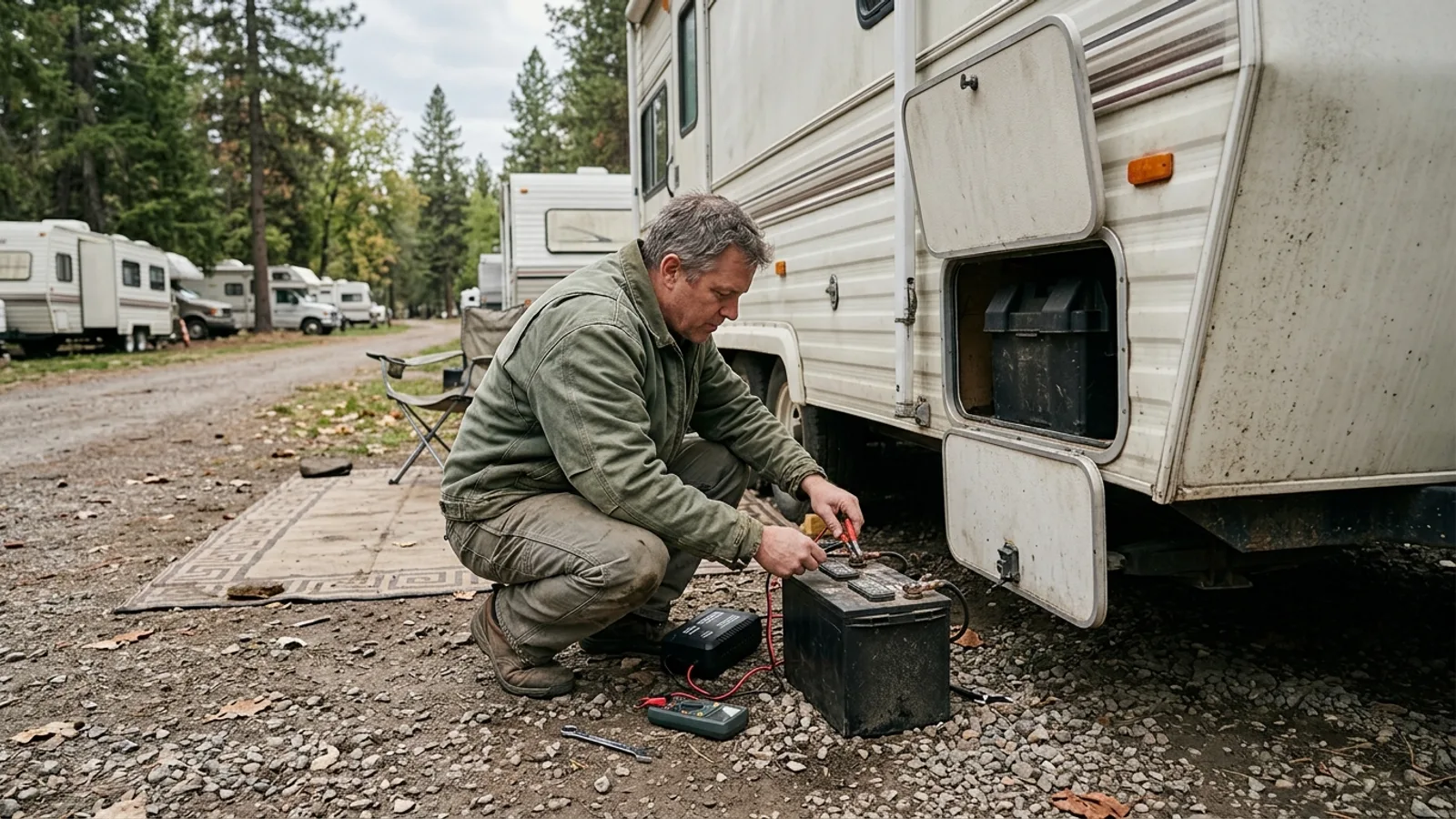
Corrosion on battery terminals can interfere with charging and power delivery. To clean terminals:
- Disconnect the battery from the RV's electrical system first.
- Scrub corrosion from terminals and cable ends with a stiff brush and a mild baking soda and water solution.
- Rinse with clean water and dry thoroughly before reconnecting.
Inspect cables and connections for fraying or looseness, and make sure terminals are snug but not overtightened.
Storage Tips That Apply to Most Batteries
- Store batteries in a cool, dry location out of direct sun and away from major temperature swings when possible.
- If removing the battery from the RV for storage, keep it off bare concrete or damp ground.
- Check the state of charge periodically, even for low-maintenance battery types, and recharge as needed rather than letting it sit fully depleted.
- Disconnecting the battery, or using a battery disconnect switch, helps prevent small parasitic loads from slowly draining it while the RV is parked.
Charging Practices That Extend Battery Life
Most modern chargers use a multi-stage process: an initial bulk charge to bring the battery up quickly, followed by an absorption stage that tops it off more gently, and finally a float or maintenance stage that keeps the battery topped off without overcharging. Using a charger designed for your specific battery chemistry, rather than a generic charger, helps avoid overcharging or undercharging.
For lead-acid batteries, avoiding deep discharges below roughly half of capacity helps preserve long-term lifespan. Lithium batteries tolerate deeper discharges better, but repeatedly draining any battery to empty will shorten its useful life over time.
In hot weather, batteries tend to lose charge and degrade faster, so more frequent checks are worthwhile during summer storage. In cold weather, a battery that's already low on charge is more susceptible to freezing damage, so keeping it reasonably charged before winter storage adds a margin of safety.