RV Gas Tank Sizes by Class: What to Expect and How to Plan Fuel Stops
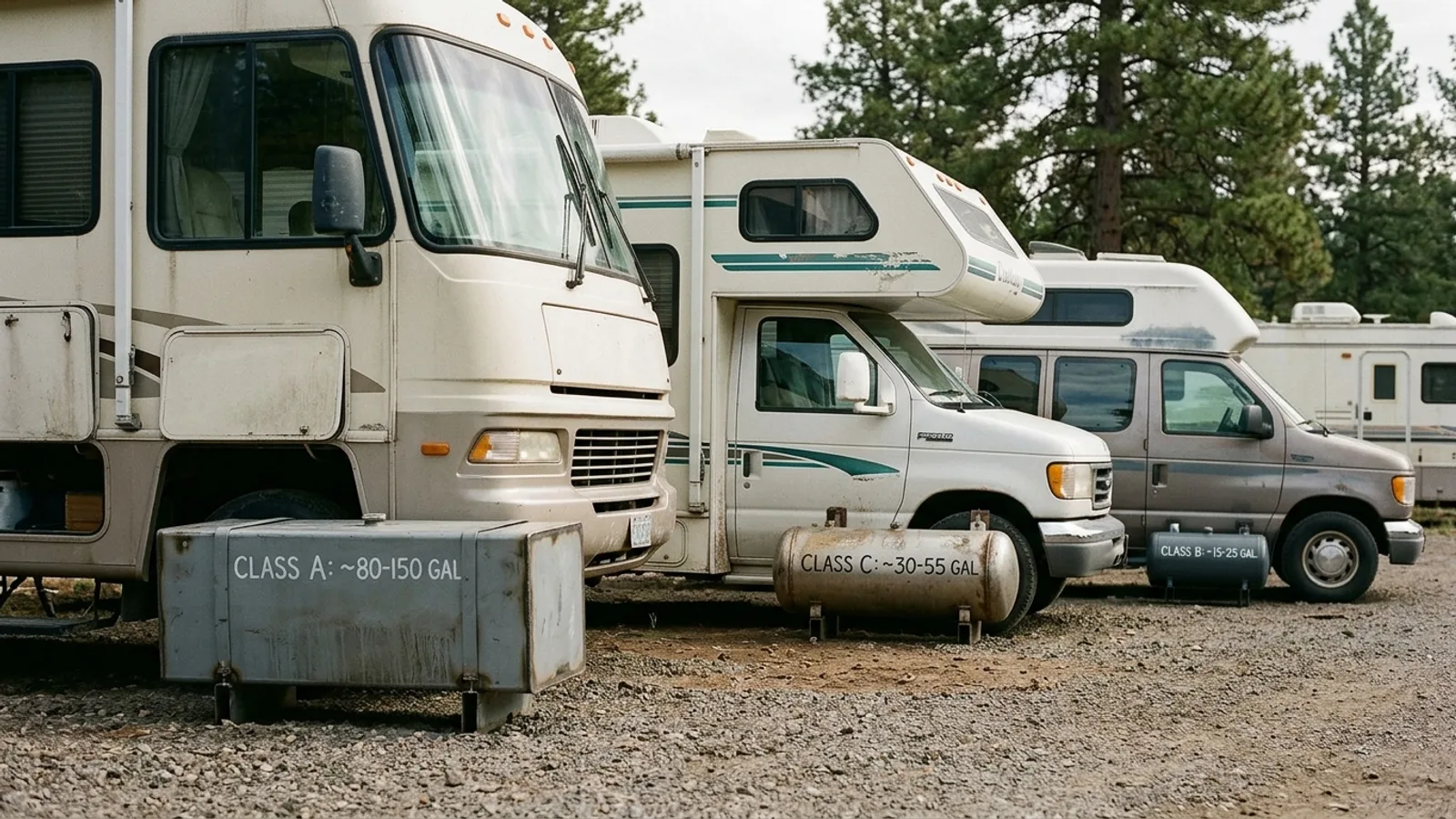
Fuel tank size is one of the most practical details to understand before a long RV trip. It shapes how often you'll stop, how you plan routes through remote areas, and how you budget for fuel. Capacity varies significantly by RV class and by individual model, so the numbers below are meant as general ranges to help you plan rather than exact specs for any particular rig.
Why Tank Size Varies So Much
Motorhomes are built on different chassis and for different purposes, which is why fuel capacity differs so widely even within the same class. A larger vehicle with more living space and a heavier frame typically needs a bigger tank to achieve a reasonable range, while a smaller, lighter vehicle can get by with less fuel on board and still travel comparable distances.
The manufacturer, engine type, and model year of a specific RV all affect tank size, so the only way to know the exact capacity of a particular vehicle is to check that vehicle's own specifications or owner's manual.
Class A Motorhomes
Class A motorhomes are the largest RVs on the road, built on bus-style chassis with full living quarters. Because of their size and weight, they generally carry the largest fuel tanks of any RV class, and many are equipped with diesel engines rather than gasoline engines. Diesel engines tend to deliver better fuel efficiency and torque for hauling a heavy vehicle, which helps offset the larger tank size with more usable range per fill-up.
A large fuel tank means fewer stops on long trips, which is especially useful when traveling through areas with limited fuel services, such as long stretches of highway between rural towns or extended drives to and from remote parks. It also simplifies budgeting, since fewer refueling stops make it easier to estimate total fuel costs for a trip.
The tradeoff is that a full tank in a large motorhome represents a substantial amount of fuel, so it helps to plan fill-up locations in advance, particularly in areas where stations capable of servicing large vehicles may be spaced far apart.
Class B Motorhomes (Camper Vans)
Class B RVs are built on van chassis and are the smallest and lightest of the three classes. Their fuel tanks are correspondingly smaller, but their lighter weight and more compact engines typically make them the most fuel-efficient class of motorhome. This combination often means a Class B van can cover a respectable distance on a smaller tank, sometimes rivaling or exceeding the range of larger, less efficient vehicles.
Because of their size, Class B vans can refuel at most regular gas stations without difficulty, which adds flexibility when planning routes through areas with limited services or narrow roads.
Class C Motorhomes
Class C motorhomes sit between Class A and Class B in size, built on a truck or van chassis with a distinctive cab-over section. Their fuel tank capacity generally falls between the other two classes as well, offering a middle ground between the extended range of a Class A and the efficiency and maneuverability of a Class B.
This balance makes Class C RVs a common choice for family trips and longer road trips where drivers want reasonable range without the size and handling demands of a full Class A motorhome.
Estimating Your Driving Range
To estimate how far a full tank will take you, multiply the tank's capacity by the vehicle's expected fuel economy. This gives a rough range in miles, but real-world results depend heavily on:
- Terrain — mountainous or hilly routes reduce fuel economy compared to flat highways.
- Weight — cargo, water tanks, and passengers all add load that affects mileage.
- Driving speed and habits — higher speeds and frequent acceleration reduce efficiency.
- Weather — headwinds and cold temperatures can noticeably lower fuel economy.
- Towing — pulling a trailer or vehicle behind an RV will reduce range substantially.
Because of these variables, it's wise to treat any calculated range as an estimate and plan to refuel well before the tank runs low, rather than counting on reaching a theoretical maximum distance.
Practical Tips for Planning Fuel Stops
- Research fuel station locations along your route in advance, especially in rural or mountainous areas where stations may be scarce or unable to accommodate larger vehicles.
- Keep in mind that steep grades, high elevations, and strong winds can reduce range beyond what flat-road estimates suggest.
- Refuel at a set point, such as when the tank reaches a quarter full, rather than waiting until it's nearly empty. This builds in a safety margin if a planned station is closed or inaccessible.
- If towing, remember that your effective range will be lower than the vehicle's rated mileage suggests.
- Check that stations along remote routes can accommodate the height and length of larger motorhomes, since not all locations have pull-through access or overhead clearance for taller rigs.
Key Takeaways
Class A motorhomes carry the largest fuel tanks and the longest potential range, often aided by diesel engines. Class B camper vans have the smallest tanks but tend to be the most fuel-efficient. Class C motorhomes fall in between on both counts. Regardless of class, real driving range depends on terrain, load, weather, and driving habits, so it pays to plan fuel stops with a margin of safety rather than relying on tank size alone.