GMRS Radios for Overlanding: What You Need to Know
Why GMRS Appeals to Overlanders
General Mobile Radio Service (GMRS) has become a common choice for overlanding groups because it strikes a balance between range, simplicity, and cost. It works well for vehicle-to-vehicle communication on trails, at camp, and in areas where cell service disappears.
Unlike cell phones, GMRS doesn't depend on a network. As long as radios are within range of each other, or within reach of a repeater, they can communicate regardless of carrier coverage.
Licensing Basics
GMRS requires a license from the Federal Communications Commission, but the process is straightforward: no test is required, and the license covers immediate family members, so everyone in a household can use radios under one license. Check current FCC requirements before transmitting, since rules and license terms can change.
Choosing a Radio
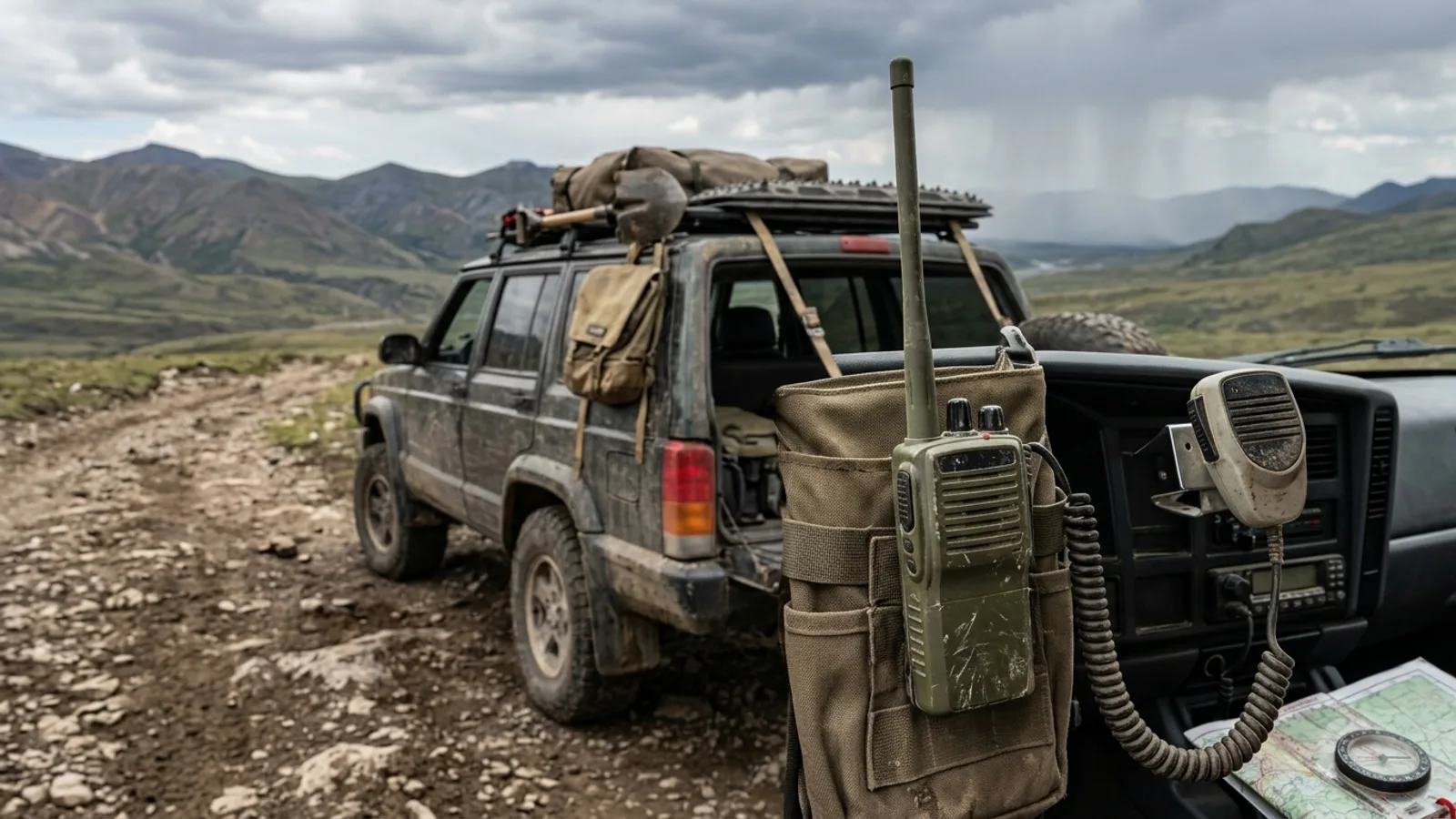
Handheld GMRS radios are portable and easy to pass between vehicles or use on foot, while mobile radios mounted in a vehicle typically offer more power and better range. When comparing options, focus on practical features rather than brand names:
- Removable antenna connections, which let you upgrade or replace antennas
- Repeater capability, needed if you plan to extend range through repeater networks
- Weather and dust resistance for rugged use
- Battery life and charging flexibility, including the ability to charge from a vehicle
- Simple channel selection and volume controls that are usable while driving
Higher power output generally improves range, but antenna quality and placement usually matter more than the radio itself.
Antenna Placement and Performance
An antenna mounted as high as possible on a vehicle, with a clear line of sight in as many directions as possible, will noticeably improve range. Metal vehicle roofs can act as a ground plane, which helps some antenna designs perform better.
Longer antennas with higher gain concentrate signal toward the horizon, which is useful for flat terrain but can perform worse in hilly or mountainous areas where a shorter, lower-gain antenna may work better. Secure mounting matters as much as antenna choice, since vibration and branches on narrow trails can damage poorly mounted hardware.
Using Repeaters
Repeaters receive a signal on one frequency and rebroadcast it on another, often from an elevated location like a mountain or tower. This allows radios that wouldn't otherwise be in range of each other to communicate over much greater distances.
To use a repeater, a radio must support repeater operation and be programmed with the correct input and output frequencies, along with any required tone settings. These details are specific to each repeater and are typically published by the group or organization that maintains it.
Repeaters are especially useful in terrain with obstacles like ridgelines or dense forest that block direct radio-to-radio contact. Knowing the locations of repeaters along a planned route can meaningfully improve communication and safety margins.
How GMRS Compares to Other Options
FRS Radios
Family Radio Service radios are simple, require no license, and work well for short-range communication, such as staying in contact within a campsite or a small group hiking nearby. Range drops quickly with obstructions or distance.
CB Radios
Citizens Band radios have long been used by off-roaders and truckers. They don't require a license and can be useful for vehicle-to-vehicle chatter, but range is limited by line of sight and can be inconsistent in hilly terrain.
Ham Radio
Amateur (ham) radio offers the greatest flexibility and range, including access to extensive repeater networks and the ability to reach emergency services or other operators over long distances. It requires passing a licensing exam and a greater investment in learning how to operate equipment correctly.
Cell Phones
Cell phones are convenient where coverage exists but become useless in many remote or backcountry areas. They shouldn't be relied on as a sole communication method for off-road travel.
Satellite Communicators and Phones
Satellite devices provide coverage far outside cell range and can be essential for emergency communication in remote areas. They require a relatively clear view of the sky to maintain a connection and are best used alongside, not instead of, radios for group communication.
Matching a System to Your Trip
For groups traveling together on trails or at camp, GMRS or FRS radios are usually sufficient and easy for everyone to use. For solo travel, long remote routes, or trips where emergency contact matters most, pairing a radio with a satellite communicator adds an important safety layer.
Larger groups spread across multiple vehicles benefit from GMRS's channelized simplicity, while those who travel extensively in remote backcountry may find ham radio's extended range and repeater access worth the additional licensing effort.
Whatever system you choose, test it before you rely on it. Confirm battery life, practice using channels and repeater settings, and make sure every driver in your group knows how to operate the radio in their vehicle.