Choosing the Right Fridge Size for Overlanding
A portable fridge is one of the few pieces of overlanding gear that runs continuously for the entire trip. Getting the size right matters more than any single feature, because a fridge that's too small forces extra resupply stops, and one that's too big eats space, power, and weight you didn't need to spend.
Matching Fridge Size to Your Trip
There's no single correct size — the right capacity depends on a few concrete variables you can actually measure before you buy anything.
Number of People
A rough starting point is to plan for a set volume of fridge space per person per day of food, then adjust based on how much you cook versus eat shelf-stable meals. Two people on a weekend trip need dramatically less space than a group of four on a two-week traverse.
Trip Duration
Short trips of a few days can run on a compact fridge, since you're not carrying much perishable food at once. As trips stretch toward a week or longer, especially in areas without reliable resupply, you'll want enough room to hold both frozen backup meals and fresh food for the first several days.
Food Storage Needs
If your meals lean on canned goods, dehydrated food, and shelf-stable staples, you can get by with a smaller unit used mainly for drinks, dairy, and a few days of fresh items. If you cook fresh meals with meat and produce, you need meaningfully more dedicated cold space, and possibly a separate freezer zone or a second fridge for drinks so the main unit isn't opened constantly.
Vehicle Storage Space
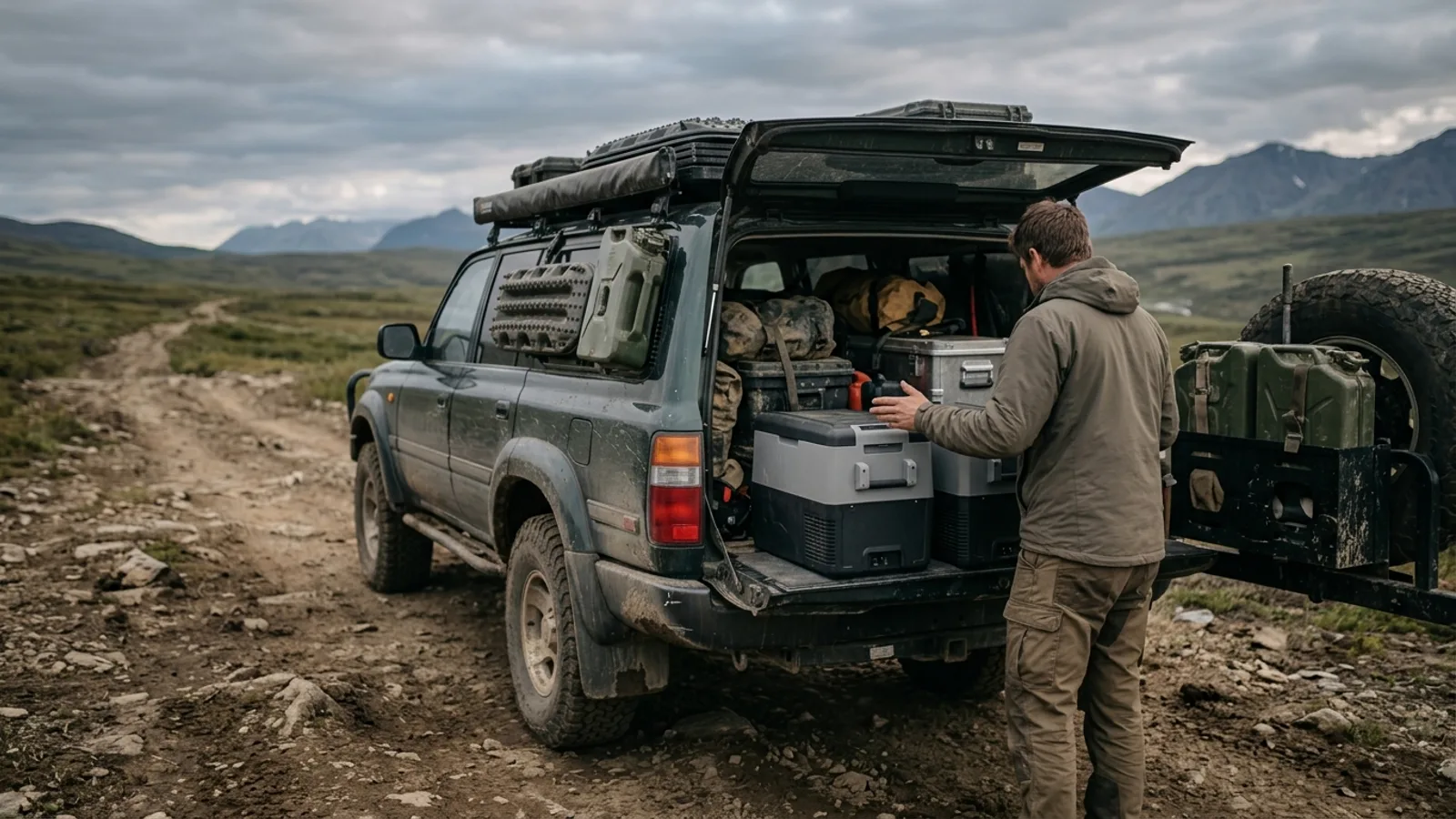
Measure the actual cavity where the fridge will live — width, depth, and height — before shopping, not after. Account for airflow clearance around the compressor end, since these units need space to vent heat, and for the swing radius of the lid if it opens upward. Also think about access: a fridge buried under gear you need at every stop will get opened less carefully and closed less securely, which hurts both cooling efficiency and food safety.
Powering an Overlanding Fridge
Most portable fridges used for overlanding run on 12-volt DC power, often with the ability to also plug into standard household power when you're at a campground with electricity. In a vehicle, they typically draw from a dedicated auxiliary battery or a dual-battery system rather than the vehicle's starting battery, so the fridge can keep running while the engine is off without risking your ability to start the vehicle.
When sizing a power setup, think in terms of the fridge's average draw over a full day rather than its peak draw when the compressor kicks on. Ambient temperature, how often the lid is opened, and how full the fridge is all affect how hard the compressor has to work. A fridge that's mostly full holds cold more efficiently than one that's mostly empty, since there's less air space to chill each time it's opened.
If you're relying on solar or a limited battery bank, look for a fridge with an adjustable thermostat and, ideally, a battery-protection setting that shuts the unit down before it drains your power source past a safe point.
What Affects Fridge Performance
Insulation and Compressor Quality
Thicker, well-sealed insulation and an efficient compressor are what let a fridge hold temperature in hot weather without running constantly. This matters more for overlanding than for car camping, since the unit may sit in a hot vehicle interior for hours between stops.
Weight Versus Interior Volume
Two fridges with the same exterior footprint can have different usable interior space depending on insulation thickness and build. A heavier, more heavily insulated unit may cool more efficiently but adds weight you're carrying for the whole trip. Weigh this tradeoff against your vehicle's payload capacity, not just against other fridges.
Build and Material
Exterior materials affect how well a fridge tolerates being bounced around on rough roads and how it holds up to UV exposure if it's mounted somewhere it gets direct sun. A latching, gasketed lid and rounded, reinforced corners are more telling of durability than the material name alone.
Compressor-Driven Units
Compressor fridges maintain a set internal temperature regardless of outside heat, unlike thermoelectric coolers, which struggle once ambient temperature climbs. For overlanding in variable climates, a compressor unit is the more dependable choice for keeping food safely cold over multi-day trips.
Other Gear Worth Planning Around Your Fridge
A few complementary items make a fridge setup work better in practice:
- Insulated sleeve or cover: reduces how hard the compressor works in direct sun or hot cargo areas.
- Divider or basket: keeps drinks separate from food that shouldn't be jostled or crushed, and makes it easier to grab items without leaving the lid open.
- Dedicated slide or mount: lets you access the fridge without unloading other gear, which reduces the time the lid stays open.
- A separate hard case for electronics or optics: keeping fragile gear out of the same storage area as food and drinks reduces the risk of spills or condensation damage.
Practical Recommendations
- For one or two people on trips up to about a week, a compact fridge is usually enough if you're comfortable with a short resupply stop partway through.
- For a couple or small family on longer trips, or anyone camping in hot climates with limited resupply, a mid-size fridge with an efficient compressor gives more of a safety margin.
- For larger groups or extended remote travel, consider either a larger single unit or two smaller fridges — one for drinks that gets opened frequently, one for food that stays closed — since separating high-traffic items from perishables keeps both running more efficiently.
- Always leave a margin of unused interior space rather than sizing to exactly fit your first grocery run; trips tend to accumulate more food and drinks than initially planned.
Basic Care and Safety Notes
Keep the fridge out of direct sun where possible, and give the compressor side clearance for airflow. Avoid letting perishable food sit above safe refrigeration temperatures for extended periods, especially in hot weather, and use a separate thermometer if you want to confirm the fridge's internal reading is accurate. When in doubt about whether food has been kept cold enough for long enough, err on the side of discarding it rather than risking foodborne illness.