Overlanding Communication: Staying Connected in Remote Terrain
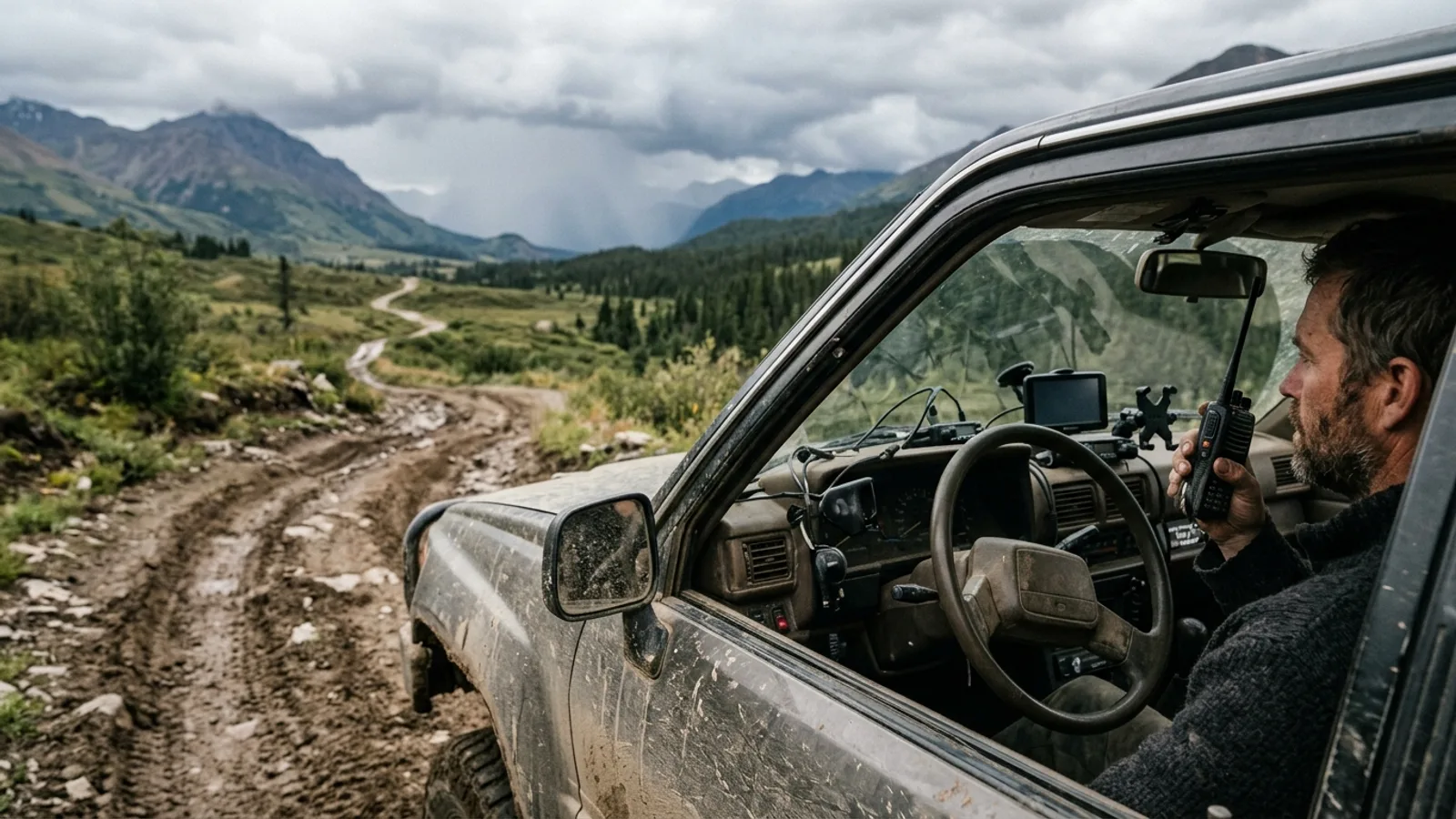
Once a route leaves paved roads and cell towers behind, communication becomes a matter of planning rather than convenience. Overlanding trips often move through terrain where a phone shows no bars for hours or days at a time. Building a communication system before you leave — not after something goes wrong — is one of the most useful things a group can do.
Understanding the Communication Gap
Cellular coverage follows population, not scenery. Many of the roads overlanders use — forest service routes, backcountry tracks, remote highways — sit well outside any carrier's network. Group members should assume there will be stretches with no signal at all and plan around that assumption rather than hoping for the best.
This means separating two different needs: talking to the people in your own group (vehicle-to-vehicle), and reaching the outside world in an emergency (getting help). Different tools solve each problem, and a solid setup usually covers both.
Talking Within the Group
For vehicle-to-vehicle chatter — calling out turns, hazards, or a stop ahead — short-range two-way radios are the standard tool. A few types are commonly used, each with different range and licensing requirements:
- Short-range consumer radios work well for convoys traveling close together and require no license to operate.
- Mid-range radios offer better range and clarity for spread-out groups, though some services require registering for a license before use.
- Amateur (ham) radios provide the longest range and the most flexibility, including the ability to reach repeaters that extend coverage over mountains and valleys. Operating one legally requires passing a licensing exam, and learning to use the equipment well takes practice before a trip, not during one.
Whichever option a group chooses, everyone should be on the same type of radio and the same channel. Mixing systems that can't talk to each other defeats the purpose.
Reaching Help From Off-Grid Areas
For emergencies, the group needs a way to reach the outside world even when there's no cell signal and no other radio traffic nearby. Two categories of devices handle this:
- Satellite messengers and personal locator beacons send a distress signal with your location to emergency responders. Many also allow basic text messages to family or trip contacts, which is useful for non-emergency check-ins as well.
- Satellite phones allow actual voice calls from remote locations, which can be valuable when a situation is complex enough that text alone isn't enough to explain it.
These devices work by line of sight to satellites, so they perform best in open sky and can struggle in deep canyons or dense tree cover. Testing a device at home and understanding how to trigger an emergency alert before you need it is worth the time.
Building a Communication Plan
A communication plan is simply an agreement, made before departure, about how the group will stay in touch and what happens if someone gets separated. For a small group of friends, this can be a five-minute conversation. For a larger caravan, it's worth writing down.
Useful elements of a plan include:
- A lead and a sweep vehicle. The lead sets pace and calls out routes; the sweep stays at the back so no one gets left behind unnoticed.
- A shared channel or frequency that everyone in the convoy monitors, agreed on before leaving cell range.
- Check-in points or times — a fuel stop, a trailhead, or simply "we regroup every hour" — so the group notices quickly if someone falls behind or takes a wrong turn.
- A plan for separation: where to wait, how long to wait, and what to do if contact isn't reestablished within an agreed window.
None of this needs to be formal. The value is in everyone knowing the plan in advance, so no one is guessing during a stressful moment.
Keeping Devices Powered
A radio or satellite device is only useful if it has power. On multi-day trips, plan for charging without relying on a single source:
- Carry spare batteries for handheld radios, stored somewhere dry and easy to reach.
- A portable power bank can recharge phones and small devices from the vehicle or on the trail.
- A vehicle's own electrical system, or a small solar panel, can serve as backup for longer trips where wall power isn't an option.
Keep essential communication devices charged before use each day rather than waiting until the battery is critically low.
Backup Signaling Methods
If electronic devices fail entirely, low-tech signals can still attract attention:
- A signal mirror can reflect sunlight over long distances and needs no batteries.
- Bright clothing or gear laid out in an open area is visible from aircraft.
- Three of anything — three whistle blasts, three fires, three flashes of light — is widely recognized as a distress signal.
These are meant as a last resort, not a substitute for carrying a working primary device.
Checking Conditions Before You Go
Good communication starts before the trip. Check weather forecasts for the whole route, not just the starting point, since conditions can shift dramatically with elevation or over the course of a multi-day drive. Where possible, check current road or trail conditions with land management offices, since seasonal closures, washouts, or fire activity can change a route with little notice.
Sharing your planned route and expected return with someone who isn't on the trip is one of the simplest and most effective safety steps available — it means someone knows where to start looking if you don't check in.
Simple Hand Signals Still Matter
Even with radios, hand signals are useful for quick communication between a driver and a spotter, or between vehicles close enough to see each other but not close enough to hear. Agreeing on a few basic signals in advance — stop, come forward, turn, hazard on one side — avoids confusion when engine noise or distance make voices useless.
Putting It Together
Reliable overlanding communication comes from layering tools rather than relying on one device. Short-range radios keep the group coordinated. A satellite device offers a path to help when nothing else works. Backup power keeps everything running, and a simple plan — agreed on before you leave — means everyone knows what to do if something goes wrong. None of this requires expensive gear or advanced training, just some preparation before the first mile of dirt road.