Choosing a Generator or Power Station for RV Camping
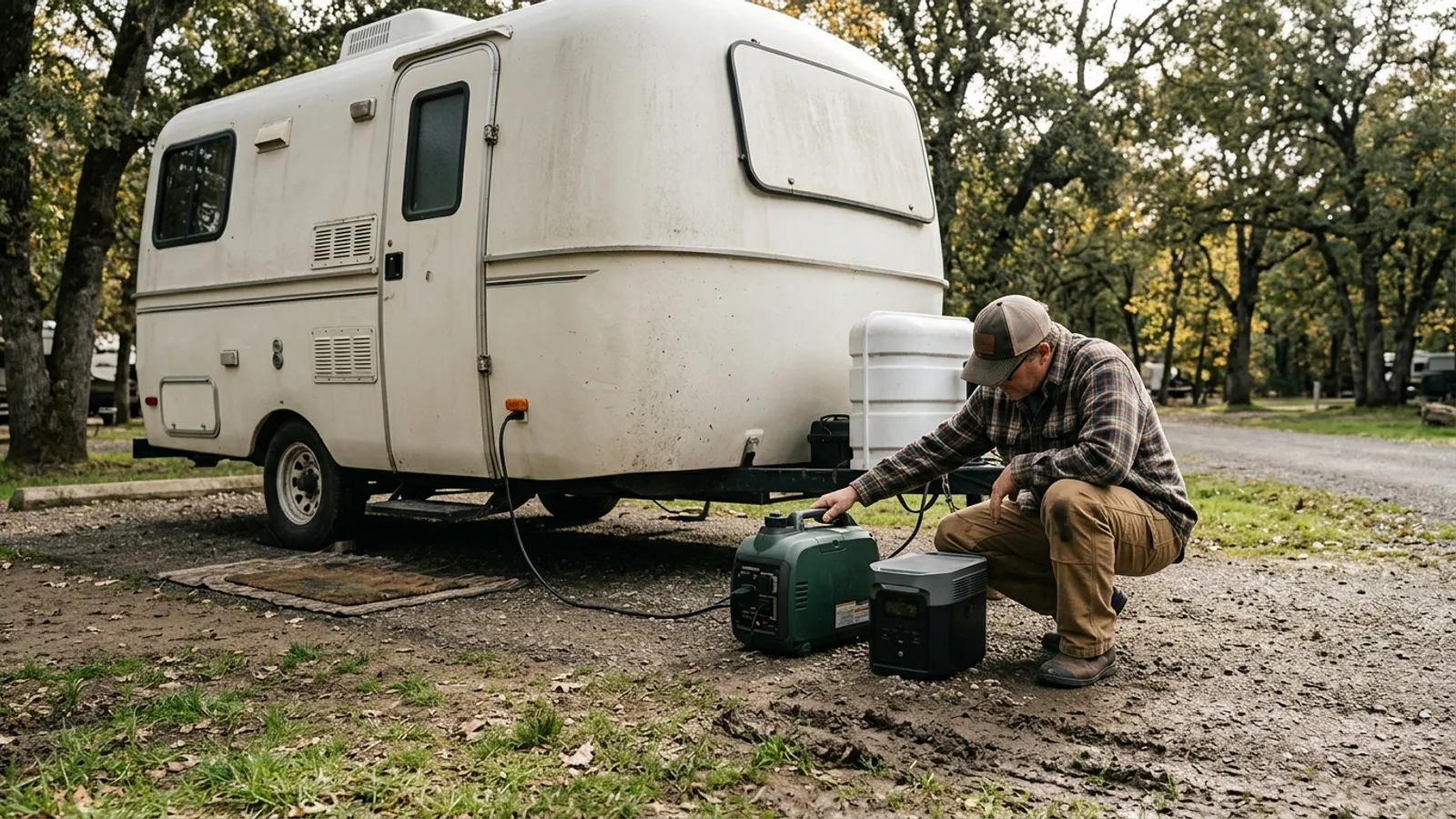
Boondocking or camping without hookups means providing your own electricity. Whether you choose a fuel-powered generator or a battery-based power station depends on how you camp, how much power you need, and how much noise and maintenance you're willing to deal with.
Two Basic Options: Fuel Generators vs. Battery Power Stations
Traditional generators burn gasoline, propane, or a combination of both to produce electricity on demand. They can run for as long as you have fuel, which makes them well suited to longer stays off the grid. The tradeoff is engine noise, exhaust, and the need to store and transport fuel safely.
Battery power stations store energy in an internal battery pack and release it silently through an inverter. They can be recharged from a wall outlet, a vehicle's charging system, or solar panels. They produce no exhaust and can be run inside a tent or RV, but their capacity is fixed — once the battery is empty, you need a way to recharge it, and solar recharging is slow and weather-dependent.
Figuring Out How Much Power You Need
Start by listing what you actually intend to run and add up the wattage. Small electronics, lighting, and phone charging require very little power. A refrigerator, microwave, or coffee maker draws considerably more, and anything with a compressor or heating element — air conditioners, space heaters — pulls the most.
Pay attention to the difference between running (continuous) watts and starting (surge) watts. Motors and compressors briefly draw much more power when they switch on than they do while running. A generator or power station needs enough surge capacity to handle that spike, not just enough running capacity for steady use.
It's generally wise to size your power source with some headroom above your calculated needs rather than running at maximum capacity constantly, which reduces strain on the equipment and gives you flexibility to add a device later.
Fuel Type Considerations
Gasoline generators are simple and widely fueled, but gasoline degrades over time if stored, and it can be harder to find in some remote areas. Propane burns cleaner and stores indefinitely, which makes it appealing for infrequent use, but it typically yields somewhat less power per unit of fuel and requires carrying and connecting a separate tank. Dual-fuel generators let you choose between the two depending on what's available, at the cost of a bit more mechanical complexity.
Battery power stations remove fuel considerations entirely, but they introduce a different one: recharge time. Recharging from solar panels can take many hours and depends heavily on sun exposure, while recharging from a vehicle or shore power is much faster but requires access to one of those sources.
Noise and Campground Etiquette
Noise is one of the most common sources of friction between campers. Inverter-style fuel generators are quieter than older conventional generators because they adjust engine speed to match the actual load rather than running at a constant speed. Even so, all combustion generators produce some engine noise, and many campgrounds restrict generator hours or ban them in certain loops or seasons — check the specific rules for wherever you're headed before you go.
Battery power stations run silently, which makes them the better choice for quiet hours, noise-sensitive campgrounds, or camping near wildlife.
Portability and Storage
Larger fuel generators capable of powering air conditioning or multiple large appliances are heavy and bulky, and they need to be stored and transported in a way that keeps fuel vapors away from living spaces. Smaller inverter generators are lighter and easier to move but have less capacity.
Battery power stations vary widely in weight depending on capacity — larger battery packs that can run bigger appliances weigh more, similar to fuel generators, while smaller ones are easy to carry by hand. Because they have no fuel to leak or evaporate, storage is generally simpler.
Run Time and Refueling
A fuel generator's run time depends on tank size and how hard it's working; running at a fraction of full capacity stretches the fuel considerably longer than running near maximum output. Carrying extra fuel extends your trip but adds weight and requires safe storage away from flames and living areas.
A battery power station's "run time" is fixed by its battery capacity and the load you're placing on it. Running high-draw appliances will drain it much faster than running lights or charging electronics. Plan your recharging strategy — solar, vehicle, or shore power — before you rely on one for an extended trip.
Safety Basics
Never run a fuel-burning generator inside an enclosed space, including inside an RV, a tent, or under an attached awning where exhaust can accumulate. Carbon monoxide is odorless and can be lethal; keep generators outside and downwind, and consider a carbon monoxide detector inside your RV or tent as an added precaution.
Let a generator cool before refueling, and store fuel containers away from any ignition source. For battery power stations, keep units out of direct extreme heat and follow basic care for lithium-based batteries, such as avoiding full discharge for long periods when the unit is in storage.
Matching the Choice to Your Camping Style
If you camp for extended stretches without access to power, need to run high-draw appliances, or camp somewhere solar recharging isn't reliable, a fuel generator offers more sustained capacity. If you prioritize quiet operation, camp in noise-restricted areas, or mainly need to power electronics, lighting, and small appliances, a battery power station paired with solar panels is often the simpler and lower-maintenance choice. Many RVers who do both styles of camping end up owning one of each.